CLICK HERE FOR BLOGGER TEMPLATES AND MYSPACE LAYOUTS »

Sunday, July 17, 2005

Soul-weeded

Every saturday during the month of June meant volunteering at some environmentally or socially motivated site. This was because hands-on work was part of our course on Consumerism and Sustainability... It is a big deal here in Oregon.

People all over the state-- at least those who can afford it-- focus on buying groceries from locally owned stores filled with local, organic produce. They sort their garbage. They recycle. They use paper, not plastic. They donate towards charities that support squirrels and old growth forests. They even fight passionately to preserve a certain spotted owl. Not to be over- wit(ty) , but such does woo even the most hardened of consumerist hearts. Ergo, it was this ethos that they figured needed to be passed on to us hardened, consumerist scholarship students.

Our first quest [this blog being a bit delayed in its postings, apologies] was thus to clean/weed out the unwanted green stuff at Jackson Bottom Wetlands. The trip commenced with sleepy grumbles about an ethereal span of breakfast time whose components consisted of frozen-- and I mean ice age frozen-- yoghurt & stolid muffins baked during the Revolution. And yes, I mean the Russian one.

We were then buckled into our seats. Sniggers rose out of the back regarding whose bottom we were going to go clean out, and such. Children.

We reached there in the misty coldness of a Portland June morning. There were other volunteers there, all bundled up and garden-gloved. We were cheerfully shown water, shovels, cookies and grass cutters... Not necessarily in that order, mind you.


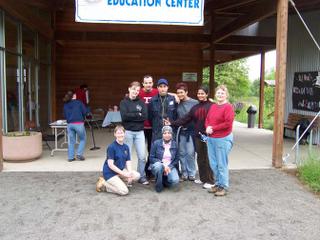
And here we are just before we started- Mary, kneeling on the left. Mary the Invincible, she is the patron saint of us scholarship students, the one who helps us with paperwork, the one who finds us friendship families, who then work as extended units of the college taking us around Portland, and showing us parades, restaurants, picnics and gorges. Standing behind her is Christy [our faithful student guide, and the driver the school car a.k.a the Walrus, coz its so huge], Adel [from Syria, gaunt, red-sweatered and grumpy. The muffins were still an issue], Bilal [from Morocco, glazed over as he was concentrating on the arabic music streaming from my ipod], Zainab [kneeling next to Mary, from Bahrain, and passionate about human rights issues and politics], Yours truly next to Bilal [beginning to miss my ipod], Ben(azir) [next to me, and still unused to the cold] and finally Debbie Anholt, far right, and the professor who taught us that course.

We set to work soon enough. The ground was assailed by bloody rakes, gashed open with spades... weed-roots screamed as we pulled them out of the scalp of the earth. Slender-waisted grass wept and swayed as we unceremoniously attempted snipping them short. The scene was that of gory and inept-- though thankfully unequal-- battle.

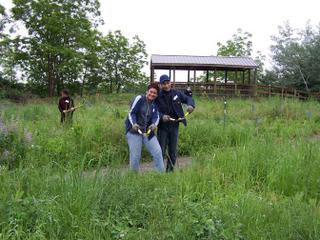
The troops acting like a bunch of pillaging vikings, laughing and posing amidst the carnage, like so:

Oh, the pity... the horror of it.

Do note that Bilal and I are holding our Weapons of Weed Destruction (WWD) far above the actual battlefield. I must confess that apart from bouts of spirited evacuation of the enemy, this is pretty much the level at which they stayed held. Sort of like U.N peace keeping forces in Africa, we remained onlookers at this great plantnic cleansing.

Do also note that I had retrieved my ipod by this time. Victory, thou soundeth sweeth.

[Hate that lisp. Comes upon me at the strangest timeth.]

Weeding we did. Flowering shrub-seed sowing we did. Earth worm hunting, garden snake finding, and looking out for eagles-- who use the wetlands for nesting-- followed. Breaks of cookies and water occured. Jackson Bottom used to be a dumpsite that is now being turned into a safe biosphere for bird and plant life. Thus though this weeding and planting is noble work, it is also unending. There is much to do, everyday. It is an environmentalist's Iraq: they cannot pull out now, but must go on.

At least the eagles and waterbirds seem to be benefitting from this toil. Aas well as the beavers and ants and earthworms and all other gentle creatures that can be found in The Wind in the Willows.

We returned muddy, and grass scented. Grass still, in whatever its form, conveys a sense of brooding, happy at times, othertimes sombre.

No ecstatic highs this time... though fyi, Oregon is one of the few states that has legalized medical use of marijuana. Doctor, I feel a pain coming on. Roll me a J. And such. But to go on-

No ecstatic highs. Ezekiel's right though: weeds show us the earth's cycle of mortality... it takes very little to get a dandelion to grow. I would let everything grow, though. Grass and weed together, thistle and fuschia shrub.

But then as Volodimir Barabash , that sweet Canadian-Ukranian says,

" Myself, I hold no grudge against the weed.

Especially, since I don't own a lawn."- To a Dandelion, that little golden devil

Friday, July 15, 2005

Of the ways we walk in, and the roofs we sit under

I can't say enough about Lewis & Clark, campus-wise. And for an already verbose person, this could be bad for you.

But hey lookie- I got pictures as well to aid the process... seeing is believing, et al.

Close your eyes first though. Yes, now.

Alright.

Imagine a sun-bright day, clouds away to the east but too far away to obscure this brilliant, almost painful blue that the sky dives into in waves. Imagine happy tiny bees who might fly into you in their glee, but then apologize softly and carry on. Imagine deliriously happy labradors chasing over lawns. Imagine cool breeze that laughed at the heat of the sun, and peeked under your skirt gallantly.

That was the kind of day at Lewis & Clark that Im going to show you pictures from:


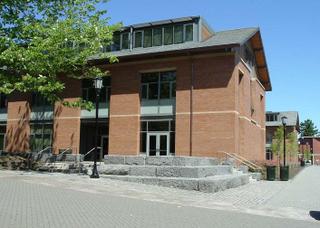
Voila. Thats Howard Hall, where all my classes are, since its just the summer session. The granite blocks are where students sit, sun themselves, smoke, wait, talk and read. My dorm is to the left, and up a gentle slope, a flight of stone steps, another gentle slope (huff, puff) and there it stands, squat and comfy with grass all around it.


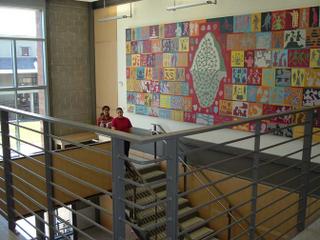
And thats inside Howard- a view of the main staircase that rises through its centre, a wall collage of impressive range, a patient Ben(azir) and a sleepy Rama. This was taken in the first week or so of me and Ben getting to LC... We were on a tour of Howard for our class on sustainability, since its built with recyclable material and installed with energy saving devices and has a environmentally-friendly, though minimalist design.

To give you a glimpse of what Im talking about, check this out- recycled carpet polymers in the sofas... those cabinets are made out of the cores of trees usually thrown away because worm paths can be seen in the final product... as fine, thin, red lines. The Y-shaped beams use less material and yet structurally hold as well as a wall of concrete. The light panels work on sensors, and dim or brighten depending on the amount of sunlight in the room. There are sound-absorbing panels all over the building, to balance the acoustics, which are great. Just ask the guy who plays his guitar with spanish fingering everyday in between classes.


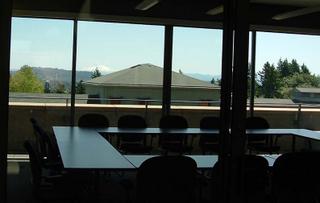
And there's one of the main conference rooms. The view looks out on Mount Hood, the friendly neighborhood snow capped mountain. As it can only be seen on clear days, It usually gets a ton of smiles from Portlanders who see it.

And finally-


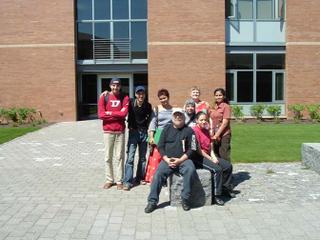
There's us outside Howard, after the tour- There's Debbie our professor standing next to Ben(azir), and David, our santa man from Facilities who took us on the tour. Here you see us smiling, coz we're waiting to tramp off to lunch. LC won an award for Howard.

It was the kind of day that a new kingdom could've been founded, world peace reached, and the ozone hole closed up. Everything was bright and beginning.

Lunch wasn't bad either.

Thursday, July 14, 2005

I wonder if Noah ever peeked in here...

... Or the three little pigs, for that matter. Here being the Rebuilding centre in Portland, where they love the concept of recycling so much that they even recycle houses.
Those that are being demolished, that is. The Rebuilding Centre, a huge warehouse cum workshop thus finds itself filled up with bath-tubs, cabinets, nails, commodes, plywood and heaters all year round.
We were driven there one saturday in June, where we helped fill a cleared up space with merchandise for the Centre to hold a sale, where those who wanted cost-effective house fixtures came to sniff around and buy, cash or card. The Centre is also dedicated to promote an environmentally-friendly lifestyle.
Hard work, I say. Brave volunteers that we are.
And yes, the natives here DO help out at places like this for free. I wonder at the motivation. And puff and pant alongside.
BEFORE

AFTER


Get yer programs here... yours truly and Rama. Notice the cool T-shirts. The grey skies. And Rama's deslike for cameras. Posted by Picasa


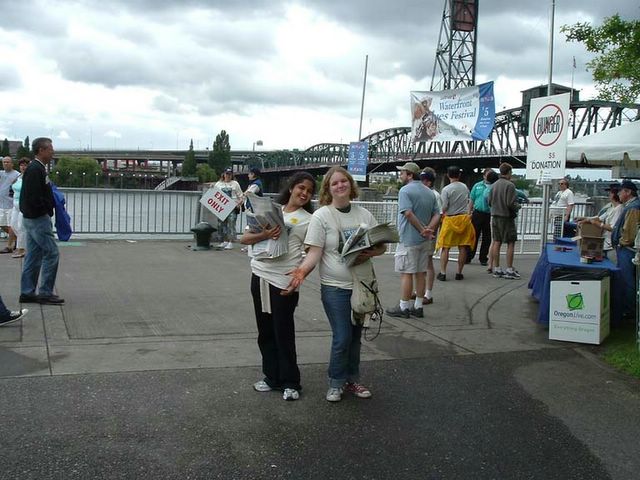
And here's tweedle-dum and tweedle-dee, the people who give me a reason to smile each day. Meet my faithful Ben(azir) on the left, and Laura on the right. Behind them, beyond the railing, is the Willamette.  Posted by Picasa


And here we are down on the Waterfront for the Blues festival, getting our briefing. Yes, that is my still sleepy, red-tinged head behind Rama's. Yes, that is Rama, third from the left and my very good friend from Jordan. Posted by Picasa

I got da ba-loooze...


... (as Gul used to say in school), on July 2nd in downtown Portland, on the waterfront.

The Waterfront Blues Festival here in Portland is an annual event that brings blues lovers and artists from around the country to the banks of the Willamette, along which people walk, smoke, stretch out, run after dogs and children, listen to great music and eat corn dogs. And since it usually coincides with the 4th of July, everyone-- And I mean EVERYone-- huddles together like happy sardines on that night and stares up the sky, waiting for the fireworks to go off.

Our intrepid group ventured out on the 2nd though- we were helping out the organizers, who happen to be Safeway [a happy chainstore found in yankville] and the Oregon Food Bank, who through this festival collect cans of food and green bills with old mens faces on them that those who visit the festival care to donate. No entry fee, give if you feel moved to do so.

Whoa.

I don't think I've ever been to a charity affair anywhere else where the audience could choose to be charitable, entry-fee-wise or not.

Another thing I was moved to whoa about? The money and food collected goes towards fighting the hunger problem in Oregon.

I didn't know there was a hunger problem in Oregon.

In fact, together with a large number of people from around the world, I didn't think it was possible for the States to have a hunger problem. All I have been told is about the U.S government dumping surplus wheat into the pacific. Rumor or not, the following fact isn't:

According to the Oregon Food Bank's website, working Oregonians in two income households have a hunger rate almost 4 times that of the rest of the nation. 2 parent houses with kids have hunger 3 times the national average.

Perspective gained, then. And a T-shirt, with the festival logo on it, and the chance to see what kind of genial animals live in the Portland Ark.

My job-- and that of three of my brave companions-- was to hand out festival programs to visitors. And thus the full regalia of the portland community burst forth first upon our eyes... and it was more fun than I have had in a long time.

I could tell you about the piercings, the dyed hair, the cyclists, the sk8er bois, the grandparents, the mexican tribes, the lone smokers who strode on full steam ahead, eyes focused on the concrete... I could tell you about the children, and the unfortunate man who asked me which blues performance I would recommend. I shifted from one foot to the other, made polite throat noises, thrust a program in his hands, and pointed him towards the main volunteer group. What can I say? Blues, though I do love it, is not my strong point.

Gregorian chant and polkas yes, Blues no. Though one day...

That day however, saw us standing there under a rain-threatening sky for 4 hours, energetically telling people to "have a great day!" and tapping the occasional foot to music being played on one of the four stages closest to us.

Ben and I even got to stand backstage, since one of the technicians figured we were having so much fun on that side of the fence, we might as well be where the action was. And I loved it. The band on stage was doing a smooth rock and roll groove to the blues their lead singer was croonin', and four couples were on stage, dancing.

Could've been you and me, or mum and dad, or the guy who works at Fred Meyer and the nice lady who serves out my spaghetti every day at lunch. They were laughing, having the time of their lives, and the crowd loved it.

God, I wanted to dance. The smiley techie guy informed me that all I had to do, like these people on stage had done, was to go find a partner.

A partner. I grinned, shook my head, and got back to distributing programs before someone noticed I had been gone. Program distribution is simpler though less fun than negotiating the intricate steps of dance and man-finding in life, and always will be.

Om.

There were ducks in the waters below the pier, sun streaming from behind clouds above. There was also an enterprising young man who had painted himself and his clothes, and his little pedestal, a shiny blue-green. To the tips of his hair, even. And then he'd stand on the edge of the crowd, on his pedestal, very still, and play statue.

People loved it. The festival should include him as one of their attractions- He kept raking in the moolah with his handshaking when people came too close, his juggling of three glass globes, and his immaculate silence.

At the end of our shift, amidst the ice cream stains... the genial security people guiding boozed-out-of-their-skulls young men to the side... the cajun food smells... the dried grass, and the crushed ciggie-buds... the whistling and clapping crowd, and the shrieking kids running in and out of gushing pools of a hydrant someone had let blow....

at the end of our shift, we went home.

The festival attracted 1,500 volunteers this year. $348,000 dollars and 107,000 pounds of food was collected. And when you got tired of distributing programs, you could blow soap bubbles for general amusement, and personal Oming.

God, I love Portland.


Epilogue to the need for bricks and free speech

It is finished.

Not being blasphemous. Fact is, it really IS finished.

The uproar was flamed, and then the growling lions tamed. Everyone got together for a moot over the issue of the article in the Oregonian: professors, students, scholarship people, other students at Lewis & Clark.

Points of view heard, the reporter and I had a talk-down over the phone- I accepted she had the right to frame an article any way she wanted to, and she accepted that generalizations will most often get a bunch of antsy international students on her case.

As a class project-- For after all, such things are to be learnt from-- We are all writing op-ed pieces to the Oregonian.

500 words.

And as for those of ye who don't think this goblin can keep to the word count- HA! All I can say to you is...

dear god, you're probably right. Sigh.

This is going to take work.

Promise to post it when Im done. Here's to a declaration of rights, including the freedom to be safe from stereotypes and all print media.

An economically worded declaration at that.

Amen.

Monday, July 11, 2005

Of free speech and the occasional need to throw a hard brick

Folks, today has been a funny day to say the least.

First, I oversleep and miss my first class, and get to my second class-- Foreign Policy-- almost, almost too late. Class was the stimulating universe in a golden vitamin C globe that it always is.

And then I got to read the article in the Oregonian, a local newspaper here in Portland, which was supposedly a feature article on all us international students here at Lewis & Clark college in the PLUS scholarship program.

The key word there is "supposedly".

People were left out. Single perspectives were concentrated on. Interviewees claim they were misquoted, or at least their views mis-communicated.

But that wasn't the worst. Oh no. Not by a dragon's ass.

The worst was the following bit (and I quote):

"...Priyanka Joseph, a 20-year-old from southern India with red highlights in her hair and the Black Eyed Peas on her iPod..."

The goblin's eyes grew to flaming cold slits. His curiously carved fingernails curved into the stone wall, the rock squealing for mercy. His concentrated frown suddenly turned an annoying but fuzzily cute blue otherwordly creature into a flat-footed evil from hell, who spewed the worst at enemies, from over-used nylon socks to insults pertaining to the unfortunate mortal's mothers. His stare caused a crack to develop in the far wall of the courtyard. A black hole appeared behind it... the servants ran screaming as the maniacal laughter of creatures locked up in the vast darkness for a thousand years rent the air with their adamantine freedom cries....

Erm... yes. As I mentioned before, yours truly was a tad peeved.

My brick thus, is enclosed below.

I warn you. It's as ascerbic as the worst tempered lemon. And why not?

No one gets away with saying I have the Black Eyed Peas on my iPod. Screw you, biyatch. Eat my flaming words.
______________________

Date: Jul 11, 2005 4:42 PM
Subject: Re: 'Classroom with a world view ', appeared in The Oregonian, dated July 11, 2005.


Dear Shelby,

I felt moved to write this on reading your article published in the Oregonian today. It is unfortunate that due to computer errors you [and I assume, the editor] got the raw, incredibly impassioned, and pretty peeved version of what I'm writing to you now. The facts in this version remain the same, I do hope that thanks to a second and third reading of your article, my outlook is now a bit more sober and more understanding that it was an hour ago. And yes, I still do want to send this out to all the people concerned, because I feel it has to do with the way we all see the world.

To summarize my draft then- I had stated that I greatly admired your writing style, and did appreciate you taking time off to come visit with us at Lewis & Clark, and hear what we had to say. The "we" being- for those who were not present on this occasion- Zainab, Lamya and I, who are all students with the Dept. of State sponsored scholarship program called PLUS. I would also like to say at this point, that you had originally planned to speak to only Zainab and I, as you had informed us via email. I say this only because I want it recognized that I would've refused your interview, Shelby, since I don't like this kind of thing, except I thought that as I foreign student here I should be polite. Next time I'm sure I will pay more attention to my own gut instinct and choices.

I then went on to declare in my draft that I personally am never one to seek out publicity especially that of a newspaper, be it even one as esteemed as The Oregonian. I then said that this response to you and those involved has nothing to do with a lack of personal limelight or coverage. I said this because I want to ensure that no one misunderstands my motives for writing this piece, which are as follows-

Firstly, I have always been a student who has written about the things that has moved me the most. In the vernacular, that would be "whatever got me ragingly pissed off". This mode of communication happened through school and my college in India, and I consider it my freedom of expression. And considering others have the same sort of personal liberty, I try, most times, to ensure that I hurt no feelings in getting my point across with as much clarity as I can muster. So at this point, I would like to say I have no grudge against any person or institution, but would just like to voice my opinion.

Secondly- The first reading of your article left me asking questions about what exactly was the story you were trying to tell: was it about a class at Lewis & Clark College taught by Mr. Partovi, a scholarship program, young Arab women in America or all these put together? I then read this article over again, three times. And I begin to see that yes, it seems to be about all these three. This is good, and gives a lot of people a lot to read about. But one anxiety still remains: it concerns the effect of such an article on those who read it, who unlike you Shelby, did not get to hear all that was being said, but only get to read what you think—and quite justifiably so—is newsworthy. I have a problem with this because of the mental image your article creates, not only of the three elements I have already mentioned, but of the mental image it creates of the other individuals referred to collectively in your article- the other students in the foreign policy class, and the other students in the PLUS program present here at Lewis & Clark College. I have a problem with this because it offers only a narrow perspective, and doesn't tell the whole story.

And thirdly—And this is a petty motive, I will concede—I'm writing this article to state that I dislike being stuck in a paragraph in your article to add colour to the theme, and a refreshing change from the general storyline. I am no one's circus attraction, really. Call it an issue of pride, perhaps. I am but human. Mea culpa. But personally I think it would've been better for your article—and myself—if you had used a general, well-sketched paragraph about all us international students, and perhaps our music tastes and restaurant preferences, as a break from the main story rather than that one reference to just me. It would've pointed out a feeling of solidarity, it would've increased interest, and it would not leave me in a place wondering why one earth did I have to be mentioned, at all?

Now that motives have been stated, I need to talk about your article.

Let us assume that each of the three elements stated above—Partovi's foreign policy class, the PLUS scholarship and young Arab women—were each individually a theme in your article. I would like to deal with these separately.

Firstly, about Mr. Partovi's class: In your article, you have stated: "Partovi, who is more conservative than many of his Lewis & Clark students, often finds himself in the minority on the Southwest Portland campus…" Now I'm not sure about how American Journalism works, but I'm quite sure that such a sweeping statement requires just a tad bit more backing up than one student, and that too a summer session student's, point of view. Of course, if you did base this statement on fact that either Mr. Partovi himself or another student or faculty member supplied you with, then I retract and humbly apologize. But as a reader, it seems a distinct judgment of the Professor's stance by the author. I bring this up because I, like other students in Lewis & Clark College, know that though Mr. Partovi does not go yelling and waving slogans with the rest of the liberal bandwagon, and though he does quite brashly declare his liking for this country that offered him sanctuary and a place to grow and live in after the Iranian Shah was overthrown and he along with the other diplomats had to flee… though these stand as facts, I know Mr. Partovi to be an intense and energetic challenger of the decisions taken by present and past administrations belonging to this country's government. I know that he himself wrote to the President criticizing the move on Iraq. I know that he questions every conservative—and liberal—policy made by every administration till now. To me, this seems that Mr. Partovi is merely a subtle and keen-eyed intellectual, and not particularly conservative or liberal. And the problem with such statements in the newspaper is that that opinion turns public since it came from such an authority as The Oregonian. Otherwise, the fact that the class is a forum for students to speak based on fact, and to question everything is true, and granted. And of course, such classes, especially for students from a crisis-laden area, is of great importance because it means that important and immediate world issues are being discussed here and now. I fully agree with your article on this point.

As for the second element: you have mentioned facts and figures about the PLUS scholarship, and how the process of study moves the scholarship students through a two year period. Wonderful stuff, as the scholarship is a great idea and an open-minded venture by the Dept of State and the NGOs involved. However, it's the grouping and the generalization in your article that I have a problem with, which is what I will come back to after referring to the third element, which is young Arab women in America.

Now I understand that for the present day and age, such a theme, an element, is exactly what pushes a story. Women from traditionally oppressive countries and systems breaking out, coming forth, saying the good word, fighting the good fight. And if your story specifically had this element in mind as the core of the article, then I concede to that as well, and will continue this response solely based on my reaction to your article. However, if this element was NOT specifically your goal, then I have issues. Big ones. For such using of a minority—or a majority—voice to give context to the state of the entire group is just wrong. So wrong. Especially since this scholarship has aimed at bringing many minorities together, not just one. Especially since it aims to look at all countries, all stories, all students, not just one.

Your article talked about PLUS students. What about the others here? Am sure not everyone's parents or close relatives are involved with some noble politically-affiliated cause, but I am quite sure that each one has as big a story: all of which would've contributed to a more authentic reading of this story of international scholarship students here in Portland.

For example: there is a student who was detained by customs officials in New York for five hours, only because they asked him who Lewis & Clark were, and he replied that he did not know. There is a student here who's bags were searched in Charles de Gaulle airport in Paris only because she seemed more foreign than her companion, and thus more likely to be carrying suspicious objects. There is a student here who received indirect religious insinuations against his faith only because he did not eat the meat offered at the meal as it was not prepared according to the doctrine of his religion. This same student had to be polite, for after all he is a guest here in this country. There is a student here who has lost family and a brother in the Palestinian conflict, and is held up as the poster-child of all those who espouse the peoples' cause in the Middle East, with none of these cause supporters realizing the extent to which other Arab nations ignore the Palestinian conflict, and how the other Arab nations abandoned the Palestinian people when they needed help the most.

Of course, even the least cynical reader at this point would probably point out that the only reason for all this rodomontade is basically that I didn't like the way I was portrayed in your article. I don't deny that that isn't true. Being the child of my parents, being at the hub of student activity, decision making, forum forming and outreach activities in my city in India, and being a person who quite snobbishly considers herself a hopeful intellectual—It was hard for me to be described by red highlights [now faded, I must state the truth] and ipod usage. In my draft, which was accidentally sent to you, there was mention of how I strongly protested my saying, ""I'm like, 'I don't do blues,' ". I stated that I would never say "like"—good god, the horror. You, in your polite and speedy response [thank you for that] said that you put it down verbatim which is why you included it in your article. I remain upset—For if that is the truth, as I'm sure it is, then America is affecting my English much more than I thought it would, which means I have to be extra careful from now on.

But seriously.

I reiterate: it is not that A received the lion's share of article time, and B was given a passing reference. I repeat, I am not one for paper rustling and name quoting. But my point is, why did you have to include me at all? Or rather, why did you have to leave out all the others? You could say that it was because you were only covering those in the Foreign Policy class. But then why refer to the group outside of the class, in the context of the scholarship, with no other points of reference other than Zainab and Lamya? Of course, I respect Zainab and Lamya as my fellow students and my friends. But I'm wondering if you could honestly feel satisfied with the authenticity of your article, when it was meant to be a feature piece on international students—all elements considered—and you leave out the bits about the rest of the group. And indeed, in writing about the class, how could you leave out the perspective of the other students or at least one other student who does take Partovi's class and is a full-time student here?

Again, I am not the professional journalist. You are. But here I am, making the case out for those who you didn't speak to, and who also have stories that must be heard.

Those who think Partovi's class is one of the few real forums for liberal, intelligent discussion of world events and views on campus.

Those whose parents fought for citizenship, and who have known what refugee camps are like.

Those who have known religious orthodoxy, and are learning to live in harmony with more than just that one point of view.

Those who lost family in the tsunami, and missed weeks of college traveling up and down the coast, contacting relief material suppliers, co-coordinating volunteers from around India and the world, meeting with district government officials, consoling families, holding fund-raisers.

Tell the whole story Shelby. Or if not, tell just one. And leave those of us who don't listen to the black eyed peas on their ipod and never will, and who dislike being used for the oomph factor, out of your stories.

But once again, thank you for your time and energy. Am sure that the PLUS program, Lewis & Clark College and The Oregonian all gained from the article. I apologize profusely if any of my views seem boorish, narrow-minded or lacking in imagination. I did however, have to say this.

Yours sincerely,

Priyanka Joseph.

Sunday, July 10, 2005

it starts

I've finally done it. Starting up the blog, I mean.

From now on, anecdotes, views, recipes, pictures, news clips, lyrics and radical environmental view points [hey, its Portland!] pertaining directly to this west coast city I love will be posted here at What The Blue Goblin Says...

Come see what the cheeky little ultramarine bugger is upto.

And yeah- tell mum.

I'd like to introduce you to Mr. Sal Taki...

... A medium height, gentle-mannered, moustachioed man who sat next to us on the flight from New York to Salt Lake city on May 14th, 2005.

Sal [or Saleh, to be authentic]lives and works in Arizona, and was on a flight back home from Baghdad, which is where he was born. Where his family lives. Where he hasn't been since he was 17, which was a little more than a couple of decades ago.

He had been visiting his family, and had just spent six months with them.

He wanted to exchange seats: thats how it all started. Frequent visits to the high-pressured hell hole a.k.a the inflight loo did not call for a window seat. "I've not been well", he said, gently crumpled in his sky blue long sleeved shirt. I nodded, and complied- God knows anyone suffering on a flight that day had my sympathy. I had decided that trans-atlantic flights were the nearest you could get to Dante's purgatory.

Actually, wait.

That wasn't quite how it started. It started, at the very beginning, with Saleh asking me something in portuguese. My startled look made him switch to spanish. A pretty disgruntled "Im sorry?!?" got him to switch to the Queen's Own. He hurried to explain that he had thought I was a latina, which is why he had tried them lingos.

Madre de dios. I was curious- First, that someone could think I looked latin. Second, that this man who distinctly looked turkish-kurdish was speaking to an Indian in portuguese. The mind swum with the expansiveness of globalization... but then recovered quickly, for Saleh Taki was speaking to me.

Im not quite sure how this happened. Americans, and anyone who's lived in America for a justifiable length of time are notorious for their ability to small talk. It took a while for me to get used to bus driver's asking "hey, how are ya?" and me answering that with a "great, you?" with smiles and nods finishing the act. But this wasn't small talk. Saleh with the smiling moustachios and tired eyes wanted to know where we came from and why, and sounded a congratulatory grunt on hearing about the scholarship. He then proceeded to tell us that he lived in Arizona, and worked a lot with mexican and portuguese immigrants and I somehow reminded him of one. Concillatory nods all around. Delta airline staff supercilliously walking up and down, straightening hair and telling people to sit upright. The pilot drawls. The plane takes off. Ben [my ever faithful companion on this trail] dozes gently. Sal and I, sitting at an incline till we reach 3000 feet, talk about his home, his family, and what he does and why he does it in Arizona.

Biochemistry called, when he was a young lad. He set out by himself then, and though visa-wise the cross-over was easier for him than students like us now, there was none of the soft cushioning we received. No talk of culture shock. No family, and few calls back home. Sal Taki came as a boy, determined to leave what he saw and knew in Baghdad, wanting a new life in the land of dreams.

He took to contracting later- Building made him feel better. And all that time-- from 17 to 21 to 25 to 30 to 38 to 45-- he didn't go back home. Didn't want to. Till six months before the day of that flight, when his father and mother told him that they were getting old, and wanted to see him.

He went. And was returning on the flight I was taking, with Ben, to a new country with a bag of my own dreams.

Maybe it was because he needed to talk so desperately. Maybe I looked talkable to. But for the nine hours of that flight, Saleh Taki filled my ears with the tale of what he was just returning from.

"And see"- he said, pulling out his shirt to point to the white undershirt he said he always wore, always- "this is where the grease stains are. See? They get there if you carry a gun stuck into your pants like that. I was always trying to wash them out".

He has a family in Baghdad city- His father is a rich man, he has sisters and a brother, and two nephews, 12 and 15, and countless nieces. He's very fond of them, and told me of how he had to bribe Damascus airport officials to let him carry gold to them: earrings, necklaces, rings... things that Kurdish uncles from America carry home to their nieces. Saleh is Kurdish Iraqi, and knows how to use a gun.

Who does he use it against?

Cats, he repied laughing a little, though not above the general hum of the plane. He and every member of his family-- yes, his sisters and yes, his nephews-- carry guns all the time, to protect themselves from looters and gunmen. In Baghdad, you shoot by noise: if you hear something move in the garden, bang, BANG! Though most times, Saleh said, it would only be prowling cats.

The women know how to use guns as well- They are strapped on to their sides as they stir pots in the kitchen. The boys, 12 and 15, have guns of their own. They use it to protect their grandparents. They have been told that the old people's safety and that of the house rests on their shoulders.

Every night and day, shootings and bombings. Saleh said his ears still rang with the sound. Sure, his dad would never leave- That land was his, he was a rich man.

Saleh never took walks... though there are parks. The only problem is that dismembered bodies, not to mention toes and fingers, litter the grass. The present state of affairs allows anyone who thinks he has an issue or a grudge to extract personal payment or revenge.

He says he's not going back there. Good food- They day he landed his sister made biryani. But his stomach couldn't take it. He couldn't, and didn't want to, take it.

I didn't ask Sal who he voted for, what he thought about the Gulf war, why didn't he mind his parents staying there. Instead, I listened, and then we ate raisins-- "watch it, those can give you the runs too"-- cream cheese and crackers. After having to repeat "orange juice" to a belligerent, majestic, afro-american stewardess twice, Sal leaned over and murmured, "you know- you should say onjus. Don't try and make them understand what you're saying. Use their word for it".

Onjus. After the peanuts, he told Ben and I that he loved shami kapoor and rajesh kapoor movies. The women were so pretty, he said, with their long hair, their saris, and their eyes. Beautiful. At some point he thanked Ben and me for being there..."thankyou for being so kind". He and Ben hummed some old tunes together. I felt my eyes close slowly... and then felt Saleh open a blanket and throw it gently over me, making sure it covered me completely.

I woke a while later; Salt Lake city was near by. Ben complained about the lack of taste in airline food... I nodded, gently smiling, at the woes of my poor sancho panza. Sal spoke about the kebabs he could make, and invited us over to Arizona anytime we wanted to visit. He did give me his number and email address. I have it in front of me now, as I type... black micro-tip held gingerly against a turblence-shaken tiny writing pad.

He got up and left the moment the plane stopped taxi-ing. Said he needed a ciggarette, and hadn't had that, or a good meal, ever since he had left Baghdad. And that was it.

No bigger pictures, no hand shaking, no recognization of a Moment. But that was what it was.

A good man, is Mr. Sal Taki. I hope he-- and his family-- sleep safe, and have lesser causes to shoot at cats in the night.

1921 SW 6th Ave, Portland, 97201

That's the address of Abu Rasheed, possibly the best little lebanese restaurant in Portland.

I'm not quite sure what you think of lebanese food, but one thing is true: after afternoons and evenings of college pasta, there is something to be said about fresh cut halloumi cheese, kebabs grilled in tomato sauce [slowly, and to perfection], and chicken shawarma with rice, yoghurt and tabbouleh that rolls tenderly over your palate like the gentle bosom of a sea wench on the HMS Seagull upon the pacific, murmuring blue-green-purpleness...

[...I of course assume the metaphor. Pirates not being a part of the extended family, inspite of my wistful longings as a child...]

... Baladi.

Which means, "coming from home" or "authentic", in Arabic. Which is the word one of my Jordanian friends and fellow PLUS student used to describe the food at Abu Rasheed. And while saying it, her eyes lit up, she laughed and spoke arabic with the family who runs the restaurant [like most lebanese restaurants here, its self-owned]and smiled and waved her hands over the food- As the rest of us did, except the arabic part.

The food was perfection. And the hookah that came afterwards?

[NB- 'The Caterpillar and Alice looked at each other for some time in silence: at last the Caterpillar took the hookah out of its mouth, and addressed her in a languid, sleepy voice.
`Who are you?' said the Caterpillar']

Bliss.

Blissful Baladi, last night's dinner and post dinner peace-hookah session was.

Double apple, out of a green burbling, gurgling bottle, through a friendly pipe with a wooden stem that seemed to cordially smile as your fingers wrapped around it. Watching the 12 go by, burbling like gods of the desert.

Never underestimate the power of the hubbly-bubbly. Or so I said to myself, eyes closed, sardined into the back of a big yellow taxi which I managed-- quite gracefully-- to wobble my way into.

It put Caroll's three inch high, laconic, blue creation into perpective. Only a bug on bubbly could've said- "That is not quite right"...

....

'Not quite right, I'm afraid,' said Alice, timidly; some of the words have got altered.'

`It is wrong from beginning to end,' said the Caterpillar decidedly, and there was silence for some minutes.

The Caterpillar was the first to speak.

`What size do you want to be?' it asked.

`Oh, I'm not particular as to size,' Alice hastily replied; `only one doesn't like changing so often, you know.'

`I don't know,' said the Caterpillar.

Alice said nothing: she had never been so much contradicted in her life before, and she felt that she was losing her temper.

`Are you content now?' said the Caterpillar.

`Well, I should like to be a little larger, sir, if you wouldn't mind,' said Alice: `three inches is such a wretched height to be.'

`It is a very good height indeed!' said the Caterpillar angrily, rearing itself upright as it spoke (it was exactly three inches high).

`But I'm not used to it!' pleaded poor Alice in a piteous tone. And she thought of herself, `I wish the creatures wouldn't be so easily offended!'

`You'll get used to it in time,' said the Caterpillar; and it put the hookah into its mouth and began smoking again.

This time Alice waited patiently until it chose to speak again. In a minute or two the Caterpillar took the hookah out of its mouth and yawned once or twice, and shook itself. Then it got down off the mushroom, and crawled away in the grass, merely remarking as it went, `One side will make you grow taller, and the other side will make you grow shorter.'

`One side of what? The other side of what?' thought Alice to herself.

`Of the mushroom,' said the Caterpillar, just as if she had asked it aloud; and in another moment it was out of sight."
-(Caroll, Lewis. Alice's adventures in Wonderland, 1865)


...

`Keep your temper,' said the Caterpillar. And in a city filled with cafeteria food, assignments, tests and like Alice, the strange need to be bigger and smaller and-not-knowing-which-is-best-

That is some bloody good advice.

Saturday, July 09, 2005

Free Music- raaging on. An important note for tune-heads everywhere.

Its came to a point where the need for a cache of good music, easily accessible online, became tatamount.

In the vernacular, that would be- "Doode- where the @#*! are my @#*!ing tunes?!?!"

Ahem.

Call it cold turkey after being separated from my D and E drive back home for so long.

On being inspired by Soumabh Sen, Esquire's idea about gmail accounts, and a certain Outlaw torn's [link to be provided shortly] idea about keeping his music interactive, thanks to my friend Gul, there now exists a gmail account filled with tracks ranging from Aventura to AC/DC... snoop dogg to Floyd [but of course]... Verdi, Franz Ferdinand, Dispatch, Black sabbath, Disney, M.S Subbalakshmi, The Knack, Rush, INXS, Cuban traditional music, Sade, Bach, U2 and much more.

The idea is that there exists a secret place filled with eclectic music that can be accessed by a certain group of people- a tad exclusive only because any messing with passwords and settings can mess up the music for the majority.

WIth this account, you can download the music you want, request for music you need, send music you think others must hear and will thus share when they access the account, and send tracks to friends and foes alike.

Musical freedom. Burn your bras, feed your draft card to a cow, and give thy finger to download bit rates and strange copyright laws.

Contact me at priyanka.joseph@gmail.com for password and account name info. Your needs will finally be appeased.

Om. And may Gmail be with you.


~*~musical quotes~*~

"Sleep now in the fire"

-Rage Against The Machine

You are the music while the music lasts.
- T. S. Eliot

Too many pieces of music finish too long after the end.
- Igor Stravinsky

I don't like country music, but I don't mean to denigrate those who do. And for the people who like country music, denigrate means 'put down'
- Bob Newhart

There is nothing stable in the world; uproar's your only music.
- John Keats

Friday, July 08, 2005

Of unkept promises, turbulent times and bubble tea

It is July, and I have things that still have to tell themselves, pending since May 13th.

It is July, and already the Egyptian ambassador has been supposedly killed, Al-Qaeda is supposedly responsible for the london blasts... at least they didn't blame Greenpeace this time.

It is July, and Iran and Iraq have signed a military agreement... China is going to buy Unacol... Japan may consider rearmament... The E.U will now scramble towards their constitution and include a military clause in it, since Italy and Germany now are shaking ever since pop went the weasel in the tube and on a big old jolly bus yesterday.

Yesterday... a thing of note, ladies and gentlemen. It has been said in U.S foreign policy class that U.S policy for a long time centred around a theory of isolation, of staying away from world issues. Till World War II anyway. At first I snorted and sniffed over this. But look at this: today's NY times carries the stories of yesterday's in London. News a day later. News which, at least here in Portland, is pushed behind news of a hustle for a new supreme court judge, a little boy's murder, and the Hilton family's new reality t.v show.

Jesus. I suppose such only makes me more grateful for Mr. Cyrus Partovi's foreign policy class. Fingers prodding into the world outside this starred and stripey continent... fingers which learn to feel the tension in central asia, the sprained tendon in sino-japanese relations.

I want to ask you so many things. About what Barkha Dutt and we the people are saying about the recent skirmish at Ayodhya. Whether the water crisis has gotten worse. Whether people fawned over good ol' Bill when he visited the coastline... whether someone took him to mahablipuram or pondi.

I want to know whether they will ever show the old man beheaded. I want to know if it was really Al Qaeda, the blasts I mean. I want to know what Zarqawi thinks he'll gain. I want to know why that lawyer quit from the defense team who are handling mr. Saddam Hussein's case. I want to know if everyone knows that pot is legal here in Oregon, though still a debatable issue.

Unkept promises. Unanswered questions. Ok, alright, the break has been long enough. Regular posting WILL resume immediately. The silence is beginning to ache. Before which- Bubble tea is a drink that is all the rage here in Portland, and consists of iced tea and tapioca bubbles that you suck up and gleefully chew through a large, large straw. To drink it, mouth full, tongue cool and chewing silently, is to be happy.

My favourite flavours are coconut and almond chocolate. The drink originated in Taiwan.

Blair looked like a hurt little boy standing outside the summit waiting to inform the delegates of the news. America has stepped up its security, especially on trains. The markets have bounced back, and the Times described the Brits as being "oddly stoic".


Up yours, mate.

And hand me my bubble tea.


Sunday, June 26, 2005

Unpoem#3: For Pooms

An old man crawls by the kerb,
Careful not to spill his memories in the street
And make a mess- for the decent people
Are walking, are walking,
For the decent people are walking to discounts and cold bagels
And don’t need distractions this Thursday morning.

An old man sits on the corner of a park bench,
A shiver begins in his arms, under his spine and he curls up more
Holding his brown paper bag full to his chest
A human bent crook against the ongoing scenery of the decent people
Walking, still walking,
Walking towards bus tickets and coin slots and pull the chord when yer ready to leave, son.

His bag holds, as he knows and crow knows--
(who was the only one who saw him, who cawed to him,
When old bones curled and gasped down the park’s stone stairway
When paper sighed and opened its lips and a few escaped that day blinking into the light.
Crow saw, Crow cawed, man crawled
To pick and put all blinking things back in, to then crawl some more and sit
Under tree, gasping and blinking now, its his turn)—
His bag holds as he knows and crow knows,
Useless, leftover bits that time had picked all the meat out of.
Things like broken words, and ink stained postcards.
One odd shoe, the nose of a kangaroo
Pieces of silver, pieces of lead
Menu cards and a used maiden head
Which was cut out of a magazine, way back in ’75.
A button off a coat, among other things of note
To this old man, who sat, curled, waiting to get used to the cold.

Waiting does not get easier with age, whatever your grandmother might say.
Old man poked a finger into the air of his bag, and felt around:
Hoary worm out of cold ground some September morn.
Leathery powdery fingers pulled a picture from within
Old eyes looked around the edges and then in the middle
Fingers touched the still shiny surface, leaving footprints as they had before
Often, so often.
Eyes trembled, then squeezed shut crying… tears which nourished a crack in the old leather
To open and smile upward, then down again, upon the picture he sat holding
On a bench along the side a busy street with people walking, talking.

A face looks back into you, smiling the way it always used to
Holding a flower that once lived, wearing clothes that were once worn
[and still are, at times, when on a Saturday morning you smile and say why not, not going anywhere.]
Your eyes are forever beautiful, love, and red and orange and vermillion still your colour.
I cannot forget, old as I am.
And you will be loved, old as I am.
Your tears I still keep here in this bag of mine,
Though it often makes the inked words runny.
Your laughter too, though it threatens to run away with my bag and my curled back
And pulls me away to the highest cliff to leap and live like Pan, just once more.

Your eyes, so warm. Your hands- How often, how many days and nights dearest
Have they soothed and questioned and kept and hugged into caring?

Flower blossoms like your hair fall over grass like this, over your shoulders, this gently, this womanly.
I cannot forget, old as I am.
And you will be loved, old as I am.

Against the flat grey street,
A curved bent back, shivers, but still sits.
Bag clutched, Crow caws.
Another day is gone down to dusk, threaded with with lights and the dreams that the very young
Decide to throw away.

Tuesday, June 07, 2005

Every thorn has its rose

And every so often, on a thorny hedge where nothing appeared except a cynical old slug... a rose opens its eyes and sighs at the door of the night that...

yeah well. You ge the idea.

Today, two of my fellow residents went for a walk. On my way to the library, I saw these two young men --one moroccan and the other japanese-- come stepping up the gently rising hill, their faces lit by the still bright evening sun that shines over Portland, roses in their hands. They stopped, with time looking over its shoulder and smiling in their eyes, spoke with me, and then I came here.

A yellow rose bud lies here before this dell keyboard, and I wonder at what it means to be a grown up and a man or a woman in this world.

In morocco they get angry if you pick the flowers.

But just this once, here, its ok.

Sunday, June 05, 2005

Two red doors

In downtown Portland, there is a building with two upper rooms. Every afternoon, these rooms fill up with men , some of whom are trying to leaves their own personal Hades, with the sounds of alcohol and drugged footsteps calling back to them. I use the underworld metaphor, because these men are told by the people who run the building with the two upper rooms that it is The Light they must walk towards. Redemption and a meal are promised if only they praise the god of baptist america. In the rooms, the men watch television, play pool, and discuss next week's laundry schedule.

On saturday morning, us international scholarship students were driven to this building with two upper rooms, in order to paint the walls of the two upper rooms a pale yellow, and the doors of the two upper tooms an earthen red. A thing that we found ourselves volunteered to do. Brushes and overlarge T shirts given to us, kindly instructions on how to pour paint followed. But rid yourself of the illusion that I disliked the idea- There was stories to be heard there, and so I went. Why pale yellow and earthen red? A breathless, blue eyed art student in a red coat assured us that they were psychologically proven to be colours that made people think happy thoughts of sharing and caring. Ergo, pale yellow and... yes, well.

Roll brushes are fun to paint with, especially if you have a nice colour and a rough surface. My compatriots laid siege blissfully to the bare walls, and finished most of the work in 2 hours. I did not paint walls. For the breathless, blue eyed student in a red coat told me there were two doors to paint an earthen red. I felt my hand go up when she asked for a volunteer.

I did this because of the thought of my grandmother, and two paintings that never lived because of me.

[I wonder at this constant need for coming full circle on all things, at this need for finding a cap for every permanent marker. Bear with me. Sigh.]

Red coat-- whose name is Rebecca-- Showed me how to open the paint tin, the degree to which you tip the thing so red goop spills out into the waiting pan. Plastic covering all things that were meant to stay unreddened, and I let the roll brush travel slowly down its first burnt sienna track on the white door.

The instinct of the hunt, that belongs to wolf and man. There is something about a tool of change in your hand, and surface area that will not fight you. Red gash at the place where thumb and forefinger meet, red glare in my sight, and the second stroke was a frenzied side swing, hard and bloody against the white wood.

My mind pulled me back to those thoughts that had me pick up the red brush first. Summer 12 years ago, and ammuma trying to teach me to bring life to tree bark on paper. It was in the stroke, the amount of water, the mix of colours, because nothing was ever solid poster paint out of a 30 ml bottle. I refused to listen, and walked away to the balcony rails, to stare moodily at the rain tree who was laughing at me. A few years after that, and the same thing happened again, except it was oils this time, not watercolour.

The red glare faded, and memories of karate kid II and the old man telling the kid to paint straight up, down. Steady strokes. Memories of ammuma telling me to not over-layer the ochre on the burnt sienna, to dry the brush more, to use longer strokes. And I did, conciously feeling ham strings and knees protest and then give over to the work they were created to do- Start from the top with a dipped and shaken roller, slow bring down, filling in edges and corners with the bristly brush.

At lunch, tattooed, moustached, weathered men, large & small, silent and loud stood in a circle, waiting for us volunteers to start with the soup before they did. Grace-- For yes, that Had to Be Said-- was 2 words from each stolid receiver of His Gifts. They said thanks for many things, like sandwiches for lunch, and volunteers who volunteered. There were some that made me say amen with toes getting a little deeper into concrete: things like "thank god for another chance, every day", "praise god for living" and "praise god for the universal power of music". Big men, alone except for their fellow tatooed and alone big men, who waited outside this rescue mission for food twice a day, who sometimes went on sponsored fishing trips. The coconut cream pie made it only more Hallmarky. And yet, and yet...

One of them, with burnished locks, bristling moustache, straight nose and piercing blue eyes sat opposite my colleagues from Syria and Morocco and proceeded to genially ask these two arab boys why they weren't eating the meat. Lesser, wiser and more non-confrontational mortals would've claimed vegetarianism. Not Adel and Bilal. In that den of bible-readers, with a salvation army outpost next door, they said the meat wasnt halal and they didnt eat meat that wasn't halal, because they are muslim.

And the beauty of the thing was that the darkest and most horrible of evils in the world today was sunning and curling itself in front of my eyes, over sandwiches and salad, in a christian rescue mission home in downtown portland. So damn simple, and so delicately done. No trumpets, but there for those who wanted to see, to see.

What ensued was no forced exorcism, no burning at the stake, no mass prayers- Just a theological debate, man on one side of the long table, boys on the other. All was said: the need for tolerance, respecting differences, living in harmony, principles differences in doctrine, a shared root holy book. Needless to say, the boys left in about 2o minutes, affronted and enraged. The man genially shook hands.

Apart from the fact that such debate is pointless, and often damaging to one's own faith in one's self, and one's perceptions... Apart from the fact that the guy in charge said the man was homeless coz he didnt have any social skills, do ignore him... apart from the fact that claiming vegetarianism or deslike would've ended the discussion then and there... Apart from the fact that I took gleeful delight in seeing the levels and onioned layers of how different people offend-- for like all 21 year olds, they do offend, these colleagues of mine-- and are offended... Apart from the fact that I still believe the boys were so pissed off due to the fact that they weren't the ones who left with the last word- Apart from all of this:

what I saw was Fear. Fear of being untolerated, fear of being prodded and poked, and noticed for being different. The need to protect, desperately, one's faith, one's self. Fear has an ugly nose, and laughs a lot.

Pie eaten, boys driven back, I returned to my red doors. I wish my grandmother could've seen the finish on them. Bends and corners and coats led up to me standing there and feeling happier than I have felt in a long time, with something I "did" in realtime.

Its hard to listen to anyone telling you how to do a thing. You fear your own right to it being taken away. Its hard having to listen to anyone tell you in a quiet and sure voice of the beauty of the god he or she believes in, who died for love, and who then asks you to talk about your god. Its hard feeling not good enough.

Adel and Bilal painted walls like heroes till lunch though. And sang arabic songs out loud while doing it. The doors are red, without any signatures, like the walls. People will use them to come and go...

As we all do. As we all do.

Wednesday, June 01, 2005

Sacagawea means "boat launcher".

The one who aids a journey. But she was also once known as "Bird woman", according to the French Canadian trapper who bought her. Charbonneau the trapper.

"Bird woman" was her name in the Hidatsa language, and looked like this- Tsakaka-wias. And yet she is more popularly called Sacagawea today. Boat launcher.

The one who aids a journey.

For that is what she did. Read more about this woman here, but for now it suffices to say that without her, the two explorers Lewis and Clark would not have found their way across, over and into the American north-west as easily as they did. With her baby son on her back-- her son who was born five days after me many years before, her son who was born on the trail-- this woman travelled with them, interpreting directions and their needs, though she was only one of the wives of Charbonneau, the actual hired guide.

This college prides itself on the spirit of discovery on which it was founded, and there are bits all over college about these two men and their team who went about charting the pacific north west.

One such bit is a statue of Sacagawea, a weathered bronzed face, with a baby on a straight back, the little face also peering with his mother's towards the horizon. Or as it is, towards the manor house, away from my dorm, away from the chapel near by.

The dorm is red brick, with automatic doors, a glass-walled lounge with a tv, dvd and a pinao missing 3 black keys, and our rooms with flags of different nations painted on each door.

My door has a defunct Angola painted thereon. It misses a sickle, so now looks a simple gothic work, on which I hope to stencil a dragon: Ich Will, sig heil, and such.

The chapel is built like a native American woman's hat, with a suspended pipe organ which goes perfectly well with my dragon idea, really. Think phantom of the opera. And that vertical perspective. Lovely. Outside the chapel, there are four granite totem carvings, meant to represent each of the four elders.

But Sacagawea's gaze goes further. I find myself walking by her often. Wondering, often, at this woman, who was bought and sold, who had a white man lift her son from out between her legs, who saw once again her land, who did not drown, who told stories of her life, who accompanied Lewis and Clark, who finally gave her son into their care for his education and upbringing, who has lakes and creeks and mountains named after her.

This college is beautiful, you know. Everything has been planned out, the only things that grows according to their own 'ich will' are the trees. Youngly ancient connifers--only a couple of hundred years old-- that stretch their bushy eyebrows up into the clouds. A lot of these trees grow in the ravine, on the edge of which stands Sacagawea.

Everything is planned out. From the oldest building on campus, the manor house, you can see the reflecting pool that shows you the icy coldness of the calm sky here, with dancing sunlight across the noses of those clouds, and the stretching, mumbling trees. Further, looking as the woman with the baby on her back does, you can see a snowy peak on a clear day.

From down by the pool, further down by the rose garden, I can see the path to take to leave the cold behind and enter my dorm. It goes by her, and the ravine.

Around me, there are bushes and portly trees, some holding their blossoms close like old ladies playing bridge, some letting them drop like sighs into silk-shorn grass, damp with rain below, silent, because the little creatures live elsewhere where the grass is not cut daily.

The flowers that drop silent are not alien. There are those in madras that fall on early summer mornings and shadowed evenings with a sweetness that makes you stop transfixed by the exquisite pain that comes from the waste of such beauty beneath feet that pass.

I picked the pretty ones that had fallen, up from the ground- much like the old lady who wrapped her sari around her tight did, bending carefully, holding gently. Only those that had fallen. Never from a branch. Never one that was not ready to go. Looking straight ahead, there was the well-planned, picturesque path back.

Feet over and into the grass, a handful of pale purple and white and berry-pink gentle softnesses in my hand.... a blossom here is as soft and moist as a mouthful of rasberry low fat yoghurt, as gentle as a woman's first kiss.

Evening came down as winds spoke and greeted through the eyebrows of the senior trees. One of whom had a lonely face on its bark.

Much has been said by me and others of land, and language. Dont blame nostalgia. It was something about this woman, Sacagawea, who was ready to go.

A blossom, made of toughest bark and root and stone, that went where the wind and water carried her. Some blossoms refuse to ever fall. They prefer being tightly held till upon a green branch one evening, they close their eyes and fall into themselves.

Some choose to fall while alive, and no matter whether they travel or not, for any way the wind blows.

I took the handful of those that chose, and left them at Sacagawea's feet. The wind blew sudden, eyes closed and lights came on in the city below.

Now I am not afraid to walk alone and unguided in nights which are cold and where the sidewalk lights are far away- Here, amidst old trees, and by a murmuring pool.

Tuesday, May 31, 2005

My december

There is a season, whether you turn or not. Everyone has one. Variations on old themes, the filigree work consists of the usual maple raging crimson leaves and pollen allergies.

For me its december.... my december. I realized this while walking back from the library this evening in Portland.

Cold winds scurry by your feet in rippling waves, coddling your toes into a delicate shade of glacial blue. Wind blows through every buttoned fastening, and the sun is there, bright, gazing intently out across the grass and fattened squirrels in long sight-lines of pale gold light, warm when you touch it, like 6 inches away from a flame.

But you do not feel warm. You do not feel May.

There are no people, and the grass does not speak, but only moves like tired people in an overcrowded bus swaying at every left turn.

The trees are magnificent, and cold here in Portland. Like the sun, and like it, they too are bright.

Sunday, May 29, 2005

Prologue

In ancient times, before setting out on a journey men and women were given talismans-charms to protect them against evil, to give them strength, to remind them of home.

Unless of course, they didnt have any time to pack. Ahem.

In which case, all that is taken is words given and the memory of a few moments spent where people came, met, gathered on cool, dark-nighted terrace, and spoke and ate and took pictures together.

Thus, on the occasion of my imminent departure for yankville on a little plane that served turbulence and iced pepsi, I hereby post these words, which I think serve best as a... not a start. A point of reference: a bodhi treeish one. My thanks to the Earl of Babbleburgh for the same- may your words remain everclear, and your heart forever free.


1. Some of the people on that terrace and some who weren't there, you will never meet again. Each will go their own way. Sometimes, paths will intersect. Other times, lines will run in parallel and meet only at infinity. Don't leave things unsaid - you never know which ones you are going to be meeting again and which ones you aren't.

2. It will feel like a loss intitially - letting go of places and people will only come after a while. When it does, it will be liberating. Don't pine for time to return. Don't hold on too tight - flow with the current of time or it will just tear you apart. Cherish the memories though.

3. Some of the new peple you meet will be more important than people on that terrace and people who couldn't make it to the terrace. Embrace them with open arms.

4. The Indian word for signifying associations between people is "bandhan" - literally, something that ties. The Western/English word relationships, signifies links. Links will free you, "bandhans" will tie you. Choose judiciously where you want links and where you want ties.

5. The part of you that seeks freedom will at times be stifled by the part of you that creates links and ties. Over time, you will find that free will only allows us to choose our chains. It will initially appear paradoxical but you will appreciate the underlying beauty and subtlety some day. If and when you do, you will come to accept the universe as a beautiful place filled with wonderful sights and sounds, places and people. Hope that day comes to you.

6. You are responsible for everything that happens to you in your lifetime. You are not to be blamed for those events though.Take responsibility. If things are good, revel. If not, learn, move on. Life is too short to be frittered away - learn to forgive yourself.

copyright 2005, Babbleburgh.

Tuesday, May 24, 2005

Intermission.

Pain.

Pain is never what comes with trumpeting hellfire and groans of the last flood and eternal torment. Pain never comes with flashlights and blue pencils. At least not the kind of pain that sits across the table from me today, and stares at its chipped nails, and then outside moodily, at the windswept gentle sunlit trees.

Pain has frayed jeans, and wakes staring dilatedly into the eyes of a paramedic who claps his hands in its face, and stares without human light at a body that’s bruised with memory and noise, and notices not the skin, but the shivering body that is a sign of life just returning from the OD sigh-post. Pain shivers, whimpers and wraps itself in a white bed sheet, hoping for death which means to be silent, quiet. Pain was born blind, and wanted to try meth instead of plasticine and prom nights to fill the empty draws that love left when it moved houses. Pain is then wheeled into a darkened room in the ER… and in a day, or two, or three, pays a bill, and walks through automatic doors, lighting a cigarette in the 4:23pm sunlight.

Pain will often go to the bars and restaurants and cd racks where memories of how things used to be still live, and will poke around in old bills and passwords now changed looking for what it cannot forget, and yet cannot feel anymore.

Pain stands under ice cold showers, and is ruthlessly efficient with toilet paper. Pain will recite “now is the winter of our discontent” and “aye there’s the rub: for in that sleep of death, what dreams may come when we have shuffled off this mortal coil, must give us pause”- And will always skip the remaining part of the Prince’s soliloquy till the line “thus conscience doth makes cowards of us all”. Pain will mutter this, and climb up over grass, and down hills.

Pain stands still when people cry, and will not run if its shoulder is made damp by someone who for a moment cannot see its funny-scary face, because of the power of that someone’s own grief. Pain will not cry except during La Amistad, and Braveheart. Why? Because once pain used to be like that, chained, and yelling for something worth something more than a credits roll.

Pain will in the middle of the afternoon like a scratching old man, remember scented hair and soft touches and jokes and pictures. And like an old man, will wonder where the cleaning lady put that album, or maybe the kids took it with them, or maybe its in the basement and maybe if I try going down the stairs alone I will fall and then maybe at least pieces of me if not all of me nose to chin to gut to groin to knees to toes will be with that album again... and peer for faded dates through faded eyes, and sleep in dust and a night where the cockroaches sniff and run by worried, knowing things will change soon.

Pain will even take phone calls, answer mails, and refuse to argue. Pain will remember numbers and will apologize like an awkward child standing alone after being hit by a Frisbee and the accompanying laughter.

Pain will then pull off sandals and run like a wet wild intent animal swift over a deserted playing field in the warm spiced mud and rain, lightly, only on toes, through driving water and lights made woozy by the curtain of water, running till the light but remembering that this night, this darkness will stay forever like a naphthalene ball among cuffs and tail-end buttons…

Pain does not remember what Shakespeare said about spring.

Pain will consider disconnecting the phone, finishing a bottle, picking up the receiver, quitting forever.

Pain will then check for its keys, push back the chair, and get up and walk away.

But only to wander in wet wild intent swift circles, with a cold long tooth of an iron comb spiked into its heel on every step down and forward.

And then maybe, like a dog at night after many circles, it will lay me down, lay you down, lay us down…

To die. To sleep. Perchance to dream. Or perchance, to not.

Sunday, May 22, 2005

From the land of hills and pine trees

There is so much to tell you. So very much. About planes, and customs officials, and hospitals, and Dimitri the waiter, a man named Saleh Taki, and all you can eat buffets, and dorm rooms, and japanese girls who walk barefoot and eat dried mushrooms... and so much more.

For all those who care and are curious, Portland is beautiful, Lewis & Clark has trees that have old gnarled noses on them, I landed here safely on the 13th of this month and the countries represented around me range from Syria, Morocco, Bahrain and Jordan, to Vietnam, and Japan.

One thing tho- Bob the blue goblin wants his own blog. Just a little space to squiggle about the way things are around here, in a world which is beyond 'Inscrutable Americans' and Michael Moore. Look out for a new clown fish in the fishbowl- will provide the link the minute its up.

For now, while I gleefully stomp through comparitive studies home work, and cross cultural psychology, here's a place where Im putting up some of the work I've done over the past couple of years, where its easier to look at since I have no more my documents to call home. And no, its not a phonemic narcissism.

[And if you think so, you needn't click on the bloody link, so wipe that smug look off thy mug. Hmpf.]

Ahem. Apologies. That goblin's been antsy ever since he found out they're passing a bill to restrict otherworldy creature snarkiness in human blogs.


Right-ho. Its
http://wheresmypencil.blogspot.com/

-Come by... and much apologies for the heavy scrolling. And to all those who know there are emails pending from my side- thankyou for your indulgence. And patient waiting. Computer lab clearance having just been... erm.. cleared, them wordy birds will follow shortly.

Unless of course the patient- and silent- waiting just means no one really wants to hear from me.

'Ulp.

*determined snort*

Tough! You're STILL getting them squawkers.

Wishes, from sweatered day times, and the ocasional cheesy bagel. Be well.

Thursday, May 12, 2005

18:09pm and counting....

Am leaving. Am breathless. Am not going to be blogging for a day, or two, or three.


Till then, god and whatever else is smiling and free, be with thee.

Wednesday, May 11, 2005

Munnsamy of the cycle-rickshaw

Forget count-downs, and send offs, and trumpets, and burning latin capitals and 11th houring. The fact is that I am to leave this country for two years in little more than 24 hours, and:

a) I still haven't packed.

b) I still haven't loaded all the music I want onto my ipod.

c) I haven't written, visited, said, called or mailed all that I set out to.

Vae victis. Funnily enough, my Fall this time is due to no hubris. This time round, my hamartia is nothing but bad time management. And Im sure if these IIM gods ever got to chatting up aristotle, I'd actually have a greek term for it.

Dischronus, maybe.

Sounds good at least.

Anyway, inspite of my tragic flaw, yesterday I set out bravely in the evening to try and accomplish filling my ipod [who's name is Arion. That's another story, another post] with music from a friend's collection- everything, from Tull to the Doobie brothers, with a whooshing sweep of the entire Pink collection, right from saucerful of secrets down to... yeah well. Its a 20 Gb 'pod, so thats a lot of songs. I set out at 5:20, hoping to put everything in at least by 8.

Pounding along the road in sweaty striding socks I realized that this would probably be the last time I haggle with a madrasi auto-driver. The thought instead of softening my outlook, turned the embering need of driving a good bargain up into a burning Will To Not Pay More Than What Was Right.

Right. So the 41 degrees had put all auto-dudes in a bad mood. No one felt sportive enough to indulge in the back-and-forth. While my fourth wet-blanket victim was puttering off in a huff, I noticed yells in the vernacular being emitted from the other side of the road. The word "meddem" was heard. Figured the guy was referring to me.

Its a good feeling, this. Being recognised on the road, even if its just for commercial need, is still a heart-warming fact. You and your money are called out to, cajoled. I two-stepped over to the one who was "medemming" and it was when I was at the exact centre of the road that I noticed the murky yellow cycle rickshaw he was standing with.

One does not pause in the middle of roads. One does, however, think of time and the lack thereof and humbly accept a 35 rupee auto-driver statement because of ipodical needs.

Me and One don't seem very alike. I stood there, letting self-righteous little puttering autos go by, letting time tick-tock on, letting more "meddems" bang on the doors of my mind cheerfully.

The cycle rickshaw man promised to get me there "fasht only, meddem". He thumped the seat and beamed at me from behind his slow dripping curtain of sweat.


I did not think of time. I did not think of still incomplete packing. I instead thought of how much fun it would be to go on my first cycle rickshaw ride just when I was leaving this country.

I delicately heaved myself onto the seat, bemused. Pulled out my phone [yes his name is STILL Barney] and began messaging 3 people of my adventure.

One of them was dad. Who immediately called up to cordially enquire whether I was sure I was feeling alright, and was it very hot outside, and maybe I should've taken a hat to prevent the heat from getting to my brain, which it evidently had already done. He then chirpily proceeded to order me off the rickshaw. I nodded, verbally, and continued rolling along after he had rung off.

The same route I had travelled everyday of my life for the past three years, for aforementioned friend lived near college. Familiar faces and canine tails passed by- very slowly, tis true, but passed by they did: Auto-stands and their inhabitants, tea kadais, a sweet mongrel with a pink nose, trees, cops, garbage piles.... slowly, very slowly.

Maybe the shot of glee was gulped down by my mind and spine the way it was because all that slow parade meant only one thing to me- I would never see all of this for a while, and when I did see it again, it would not be the same way. And I would not be the same way either. And that is good.


A bit of a feel of Caesar re-entering Rome with captured nubians then, but that all ended the moment the rickshaw, the white shirted-dhotied sweating man and I came upon the over-bridge near my house. Its then that I started concentrating on Munnsamy.

For that is his name, as I found out later.

From where I sat, I could see his cable-thin tendons stretched and could feel the immense deluge of sweat that can only come when you peddle me up an lazily curving bridge in traffic under a 41 degree sky. He was just one strained line, from his neck to his ankle tendons, was Munnsamy. Shiny mahogany, all these men of southern dust. Slight, with a face roughly carved out of the wrinkly shell of a nut. This little man in white peddled till he could no more, then hopped off his cycle to guide his rickshaw through traffic and carry me over the bridge.


The bear went over the mountain,
the bear went over the mountain,
the bear went over the mountain
to see what he could see.

Sigh.

Funnily enough, my half sheepish, half furtive and all amused looks around me showed me that no one thought it was funny for Munnsamy to be pulling this large, red-haired person up a bridge on a vehicle usually used for midget school children, squalling in bunches of 5's and 6's, all wearing blue uniforms and water-bottles. No police men yelled, and buses though lumbering whales otherwise, gently grumbled by, letting him pass.

Letting his pass. In a city where everyone is trying to get as fast as they can to wherever they must be, no one yelled at Munnsamy. This struck me as pretty cool, and I say that because there is no other phrase that can catch the unconcerned nuance of the thing. Madras may have killer water-lorries, ambulances who use their sirens to get through traffic lights, and multiple lane traffic which lack yellow lines.... but it does have a heart and roadspace for cycle rickshaws.

Munnsamy finds the leftest side of the road the moment we reach level ground, the ends of both his legs firmly planted into pedals that pump slow down and over.

The ends of both his legs, firmly planted into pedals that pumps slow down and over are just stumps. Munnsamy has no feet. He told me that an electrical cable fell on them and that's how it happened. This fact was preceeded and followed by him earnestly mentioning his four children. He later said there were three- whether due to a sudden burst of conscience, fatigue or coz he considered 3 a more auspicious number than 4, which it is, Im not sure.

The entire experience was punctuated by me appealing to him with my pidgin tamil to please stop, very nice now will pay already late. To which, Munnsamy wiped his face with the palm of his hand briskly and shook his head at me with the ferocity of a hippopotamus who's been interrupted in his first mating of the season.

I was overwhelmed. This little man would not let me down. No reasoning would work- He had undertaken to peddle me 4 kms, and peddle me he did. The last half a km was punctuated with him mentioning hospital visits and children's sicknesses and such.
Which I also like.

Get this straight, Jack Canfield. Chicken soup may work elsewhere, but here our stories are more simple, our angels more uneven-tempered, our sacrifices often at first hesitant and often-jovially so- grumbled about with family and friends.

How on earth am I supposed to know the right price for a cycle rickshaw ride of 4kms in evening traffic? I was an hour late, and a steel knob and my coccyx became close friends. And yet- he had peddled like a trojan hero, if trojan heroes did ever cycle. He had stumps that he capitalized on only while disputing the fare. He sulked when I gave him 50 bucks. Him showing me the telephone number of his children's teacher, saying that she would verify that what he said about his kids was the truth. Me handing him notes with all the "sandhosham" or happiness and gratefulness that he invoked when I asked him "how much?". That followed by the mutterings, the grumblings. Exasperated, I asked him why can't you tell me a price and I will pay?

No. Out of "sandhosham". I jumped across the road and scurried into the lane in which my friend lives, leaving Munnsamy to ask for water from a nearby watchman and peddle wherever else he had to go.

"Sandhosham". That's all I suppose he lives on these days, apart from his determined peddling, albeit the lack of toes. Achilles had more written about him, but was lesser than Munnsamy. There, a pierced heel killed him, and much pollution coz of pyric flames and then- Nothing. Munnsamy grumbles, mumbles, sweats and cycles with stumps that he walks and cycles with.

"Many heroes are not yet born, many have already died.
To be alive to hear this song, is a victory"
- West African Song.

Someone please tell me what I should've payed him. And yes- albeit sounds good too. Like Dischronus.


A post on the way, but while it comes... YIPPEEEE!!! Got the entire forever gold collection of Freddie and crew on my ipod. Life is beautiful. And still has a kind o' magic. Posted by Hello

Thursday, May 05, 2005

she who "caught and sang the sun in flight"

Sister Basil Quinn died on April 28th, 2005 on the Church Park campus, in her bed, quietly and in peace.

She was an 88 year old Irish nun, who scorned all forms of transport except walking and the public transport bus service in Madras. In fact considering the constancy of human nature, if not human emotions, I’m pretty sure even if they did have a shuttle service at the pearly gates for senior citizens, she'd probably make a particularly rude Latin gesture in scornful benediction and then proceed to stride past a jaw-dropped St. Pete right up to His Throne- At which point she would then proceed to discuss the bad roads on the Way Up but at least there wasn't a water problem up here, yes? I should hope not!! Tea? Yes, I would love that, thank you so much...

That was Sr. basil's way, and so much more. How did I know her?

She lived in the convent that administered the management of the school I studied in. The school was everything all convent schools are in this part of the world- Green pinafores with bloomers [elasticated puffy shorts that would be used in every impromptu school Shakespearian production if the students weren't yet in the 11th grade. Once you were in the 11th, the faculty suddenly decided that you had a new found dignity that didn’t allow for bloomers on the outside over stretch tights while lisping "now is the winter of our discontent"], which turned to salwar-kameez in the- yes you guessed it- 11th grade. There were the voice raining classes, where we'd shriek along in F minor to Tom Dooley. There were the art classes where we were taught everything from painting to embroidery: I escaped from the embroidery coz my grandmum used to be art teacher there- ha! I'd claim a piece of art paper and would then proceed to demonstrate in water color what Dali would've done if he squished a cheese burger at a Macdonalds only to find a black beetle scurry away gasping carrying a very tiny pomegranate on its back. Swear to god. Still have the painting to prove it. [Proof of love, btw- mum keeps everything I scribble or dribble paint on, even things like this].

In this school, we had the usual mix of twisted morals emotions and sexuality that only exists when you have a bunch of women living together most of whom have been there studying for 14 years of their existence, and most of whom have never interacted with the male specie other than the occasional cousin or hopeful neighbor. Nothing particularly decadent at all- THAT came with college.

[A blue tail flickers out my door, gurgling as I fling my hairbrush after it. There should be a ban on rude blue goblins. At least red goblins are "meant" to be rude. Geez.]

We had great teachers. And not just in English- One thing I will say for my old school: no other convent school had teachers like ours. May their tribe increase, at least the few I’m referring to. They called a spade a spade and weren't above dragging you out by your flagging conscience and standing there calmly-metaphorically- till you shoveled your own shit. I respect them for that. Any respect I have for authority comes only because of them.

Anyway. Life would've gone Jane Austenly in that school if it hadn't been for a few things- One of them was Sister Basil.

She and I met in my grandmother’s art room- 80 something and beginning to get extremely forgetful, she nonetheless had an Irish lilt and blue eyes and laugh that had my attention glued- to what she was saying, to the energy I could sense, to her humor and the fact that she like me thought all hierarchy sucked- its funny, even when she's spoken of God which has been once or twice, I never heard any snivelling remarks about masters and sheep.

You couldn’t help liking this lady, really. She never let the fact she was a nun act as a buffer between the world and her mind. She walked everywhere, alone. She spoke with everyone, had an opinion on everything, and stayed in madras because she preferred the weather here. Ireland, she said, was too cold.

I loved her. Still do. With her the little things and the big things were the same; you could never have trivial conversation with her- your real opinion, who you are, or nothing thank you very much. AND you can KEEP your tea! That’s how she was.

I remember bunking a two-hour math period in the 9th and going looking for her in the convent. An India-Pakistan match was on, and she called me inside the convent to watch it on tv with her. So aye, I couldn't be caught for bunking coz I was on holy ground-

[Apologies, Mrs. Grace if you ever read this. I did the math, and this too added up. Thanks for the algebra]

So I didn't tell her I didn't like the game, let alone understand it. I didn’t have to. The tv was on, goodday biscuits munched, but Sr Basil and I talked about walking in grace- the thing that Virgina Woolf called 'moments of being'. I told her .. what did I tell her?.. All those things that we who feel too much and are taught that it isn’t decent to talk about in public: the writing, the things in my head, words like god and honour, things that were mumbled and rushed over and throat-gulped out, but which she listened to, and nodded, and told me her own stuff- about Ireland, and walks, and people and herself, and faith.

In the car park one afternoon, she and I met and spoke of car prices, and she told me she was getting older. I told her I wanted to take over the UNO and restructure it. She and I laughed and planned under the sun.

When my theatre group went around to a group of city schools taking a poetry-in-performance rehearsed reading with them, I felt a strange kick in the gut when I heard we'd be performing in my old school. It was a good program we did, in association with the British Council, where we took poems from the kids' syllabus and performed them- Stuff like 'the rime of the ancient mariner' and 'the frog and the nightingale'. That afternoon, in front of kids, a few of who had been my juniors- I got up and did Diop's Africa. And Sr. Basil was there.

I had met her in the convent an hour before the show, with two of my very dear friends from college. I stood still when she came bustling out and I said, "Do you remember me?"- I had heard that she had begun to forget faces and places. She slapped my shoulder in a way that I can only describe as smartly, and then said-"of course I do, Priyanka. So what are you doing now?"

She sat with us for a bit, telling us about all the surgery people her age were getting in Ireland, where she had just come back from after visiting her family. She told Vaish, Darsh and me that when she was young, plates were things you ate off, which were found on tables at mealtimes: Not in hips and shoulders and such. Plates, indeed.

She's not too keen on medical aid, Sr. Basil.

I met her last on dec 1st, at the end of a world aids day march. It was six in the evening on marina beach, with kids in red t-shirts leaving in ones and twos and threes. I saw her suddenly, sitting right there on the pavement ridge. Tired, but still alive. She had come to the beach that day and saw our procession and came to watch. I told her of all my grown-up plans and fears and sureties. She smiled wryly, and reminded me to not forget. That’s the best part, you didn’t have to explain anything; she saw it on your face. To not forget. The sentence ended there, made sense anyway.

She had a cataract issue for a couple of years. It came back after she tried having it nicked. They found out 5 months ago it was because of a tumor in her pituitary gland. She lost sight in both her eyes then- she only said it was hard, all this darkness, when she was used to seeing so much.

An auto was driving me past school on the night of the 28th. A board outside gave me a time and place for her funeral. Till then I had never known that her last name was Quinn. I went the next day to see what was left of her, just after my visa was approved at the USIS building next door.

[A bit tragic-mystic-funny, all this passing and passaging and trips across borders]

She looked whiter than she ever did in life. Cotton stuffed everywhere, and her thumbs tied together across her chest with little bits of cotton bandaging. She didn’t look like her, at all. Sr. Basil is the first human I've known and personally interacted with whom I've seen dead. I’m not too good with portly relatives doused in jasmine and agarbati- these I do not know and do not want to know. But Basil was a different matter.

I had known she was ailing for 3 months. I had wanted to go see her. I had wanted to go tell her of my bruises and thoughts and screw ups and plans and ask her what do I do now sister, do you think I can still walk and fly the way I used to, the way you used to know I could?

Futility.

That word didn’t leave me all day. It had begun the previous evening, when I had seen that chalkboard with her last name and a date underneath it. It continued when I saw the teaser campaign of Peter England shirts, where some poor sot had evidently toiled over it, but people were speeding by the damn thing, trafficking, radio mirching, spitting, cursing, driving but not seeing the damn ad at all. It was still on the next morning when I saw the way cashier clerks- Indian cashier clerks-worked inside the US embassy. It made me lean against walls and want to laugh when I saw how scared the visa applicants were, how afraid to talk, how they had all taken trouble to dress up. I laughed into the jeans I was in that a sniffer dog ten feet away yelped at and then ran away whining from. I then went to see her in a long glass box, with way too many suffocating flowers everywhere.

Nuns were mumbling litanies. Shoes off outside... I walked outside after talking one look at her. She wasn’t there at all.

That’s the thing with Basil. She, who flagged down buses. She, who refused to be dropped back by car after concerts or plays. She, who laughed and trotted and borrowed 10 bucks and made benedictions only when she knew you needed something more than a hug. She cannot die.

I was standing in the loft at the chapel, staring at a cloth-covered cross, a prosperous lizard, and a lot of ruby-shined cobwebs, lit up by the sun filtering through the stained glass. Futility? Not so. Owen wrote that poem for young men who died in a war that wasn’t their own. The peter england ad was still rubbish. The US embassy was still a morbid joke. But Basil's life was not futile. She lived the way I can only dream of- free of the emotional bull of a non-nun life that ties one up in knots, she walked free and energetic, drinking tender coconut water and learning Tamil.

I only wish it hadn’t been blindness at the end. I would’ve liked her to have seen one last sun.

For this scholarship, I had to write 7 "essays"- which in yank terms, meant 7 paragraphs of 120-200 words. I laughed. And in September, on the last day of submission, at 3:25pm when the deadline was 4:00pm, I typed out those essays in Anjana's house. Mum pacing up and down the room behind me.

The most unforgettable person you have met, someone who ahs inspired you, and in what way?

Sr. Basil.

I wrote an essay as part of the application for a scholarship offered by the US dept of state and the Fulbright commission telling them about a little old Irish nun and car prices and faith and bunking math class.

I wish I had spoken to her before she went. Even if it was only her saying my name. Sure, the pope too had wit and god's grace. But Basil braved PTC buses. No pope could beat her. She was cool, she was Irish, and she was a woman.

Was?

*tiny grin*

Walk on, sister Basil. I will not forget.

Wednesday, May 04, 2005


May all those who have run with wild horses, felt the unforgettable fire and walked on be blessed with concert tickets. Apparently there's a contest on to win 2 of 'em to the gig in Manchester. Meself hoping to catch them on the American leg of the Vertigo tour.  Posted by Hello